
Re-entry into the list could have far-reaching consequences for Pakistan, including diminished foreign investment, increased borrowing costs, and tighter scrutiny from global financial institutions.
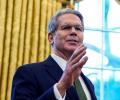
As in-person negotiations between India and the US kickstarted on Wednesday, Treasury Secretary Scott Bessent said he expected India to strike the first bilateral trade deal to avert President Donald Trump's reciprocal tariffs.

This is the first case involving India and the US at the WTO after both sides decided to withdraw all seven pending cases at the WTO during the Biden administration.
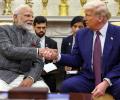
'I certainly hope the two can avoid a trade war and believe they will.' 'I expect some in India will push for retaliatory tariffs if the Trump administration applies significant reciprocal tariffs.'

Industry associations and companies in the United States, including the US Chamber of Commerce, Coalition of Services Industries and the iconic bike company Harley Davidson have called on the Donald Trump dispensation to push India to reduce tariffs, non-tariffs, and regulatory barriers to boost American exports.
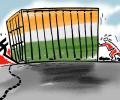
European Union (EU) companies operating in India want New Delhi to streamline or remove non-tariff barriers such as Quality Control Orders (QCOs), complex Customs procedures; simplify labelling, testing, and import procedures; and facilitate cross-border digital transactions without data localisation constraints. These are results of a Business Sentiment Survey, 2025 conducted by the Federation of European Business in India (FEBI) ahead of resumption of negotiations for a free trade agreement (FTA) between both the sides scheduled to be concluded by year-end.

'The answer is not for me to give. The answer either way has to be heard from the industry itself. Tell us why not if you are not doing it; tell us if you are doing it -- why should this question remain unanswered?'

Using the debt-to-GDP ratio as a fiscal anchor aligns with efforts to promote fiscal transparency through proper disclosure of off-budget borrowings.

'Spend, but create assets, spend but make sure that people benefit from it.' 'This has been a beautiful guiding principle. And I think as a finance minister I owe so much to the prime minister for keeping this path clear before us.'
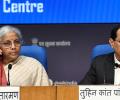
'Our attempt to honour the taxpayer has been since 2014 and more actively since 2019-2020 onwards.'

'We are not incentivising the old tax scheme. These taxpayers will also shift to the new regime after comparison.'
'Going forward, the encouragement would be to move to the new tax regime.'

'Inflation is not good for industry. Nor for the economy as a whole.'

'We have to retain some fiscal headroom without compromising on the promised fiscal consolidation roadmap.'

'It has also outlived its initial purpose of reducing physical gold imports.'

As RBI governor, Sanjay Malhotra will have to give the highest priority to the interest of the economy while deciding on the growth-inflation trade off at Mint Street.

It will be the second Budget of the Modi 3.0 government and eighth straight Budget for Nirmala Sitharaman, rare in Indian polity.

'Not paying workers enough will end up being self-destructive or harmful for the corporate sector itself.'

'We don't have to go abroad for anything.' 'Anyone who thinks we have a lot to learn from the US needs to have his head examined.' 'We are in a new era.'

India stares at the risk of an influx of Chinese products as US tariffs on a range of Chinese goods, including solar panels, electric vehicles, lithium-ion batteries, syringes, and steel, are set to take effect from September 27. With higher tariffs reducing China's access to the US market, there is concern that China may divert its exports to other markets, including India, which could lead to potential dumping of goods. This situation could challenge Indian industries, particularly in sectors where competition with Chinese products is already fierce.
 © 2026 Rediff.com - Investor Information - Advertise with us - Disclaimer - Privacy Policy - Sitemap - Feedback - About us - Terms of use - Grievances